
Twitch Grass: Complete Identification, Control, Prevention, and Lawn Care Guide
A healthy lawn creates a welcoming outdoor space, but persistent weeds can quickly undermine its beauty. Among the most challenging invasive grasses homeowners encounter is twitch grass, a fast-spreading perennial known for its extensive underground rhizomes and remarkable ability to regenerate after disturbance.
Understanding how twitch grass grows, spreads, and responds to different control methods is essential for achieving lasting results. Whether you’re managing a home lawn, vegetable garden, landscape border, or agricultural field, this guide explains everything you need to know—from accurate identification to effective removal and long-term prevention.
Understanding Twitch Grass
Twitch grass is a perennial grass species that spreads primarily through underground rhizomes rather than relying only on seeds. These white, creeping stems travel beneath the soil, producing new shoots that allow the plant to colonize large areas rapidly, making complete eradication particularly challenging.
Many gardeners confuse twitch grass with ordinary lawn grasses because of its similar appearance during early growth. However, its aggressive underground network, rapid recovery after cutting, and ability to invade cultivated beds distinguish it from desirable turf varieties.
How to Identify Twitch Grass Correctly
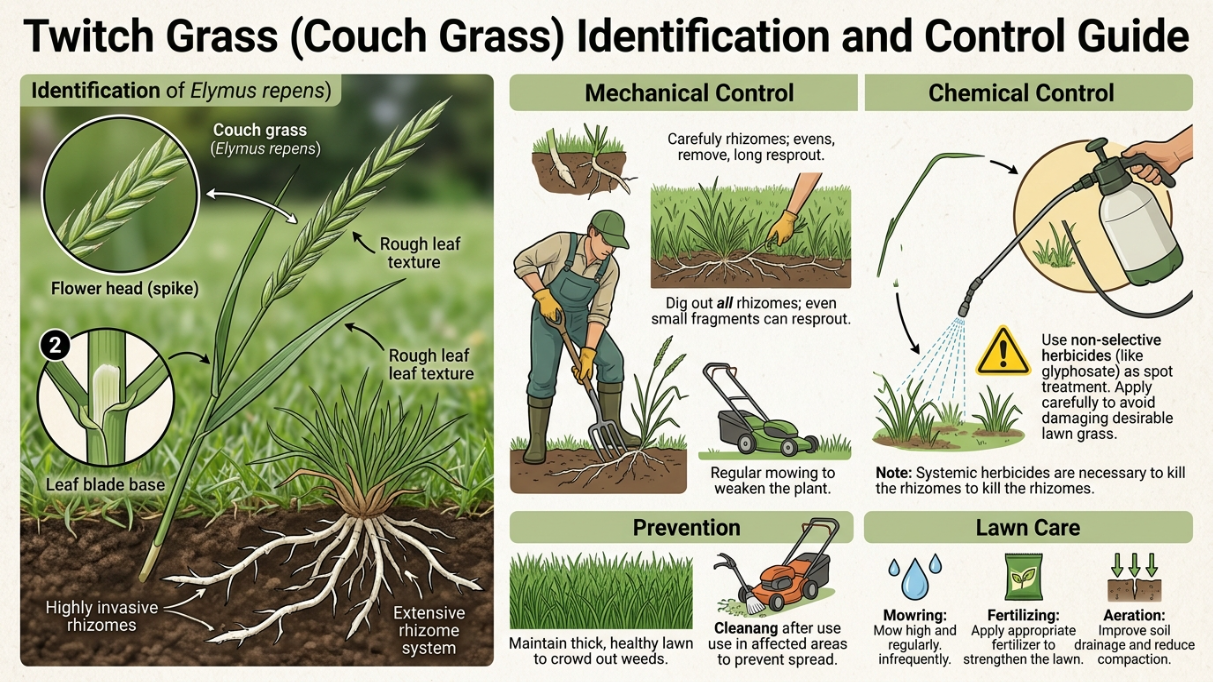
Correct identification is the first step toward successful control. Twitch grass typically features narrow green blades, upright stems, and vigorous underground rhizomes that snap easily when pulled. Even small rhizome fragments left behind can develop into entirely new plants within weeks.
Examining the root system often provides the clearest confirmation. Unlike clump-forming grasses, twitch grass develops long, pale rhizomes that weave through surrounding soil, connecting multiple shoots into one resilient underground system.
Why Twitch Grass Becomes So Invasive
The primary reason twitch grass spreads so aggressively is its underground rhizome network. These storage structures contain enough energy reserves to regenerate repeatedly after mowing, digging, or mechanical damage, allowing the plant to survive even under stressful conditions.
Open soil, weakened lawns, excessive cultivation, and inconsistent maintenance create ideal conditions for expansion. Once established, twitch grass competes aggressively for sunlight, moisture, nutrients, and growing space, often reducing the health of neighboring plants.
Common Places Where Twitch Grass Grows
Although many people associate twitch grass with neglected lawns, it thrives in a surprisingly wide range of environments. It commonly appears in vegetable gardens, flower beds, orchards, pathways, fence lines, construction sites, and unmanaged landscapes where soil disturbance occurs regularly.
It also tolerates varying soil textures, moderate drought, and changing weather conditions remarkably well. This environmental flexibility allows the grass to spread across residential properties, farms, parks, and commercial landscapes with minimal difficulty.
Lifecycle and Seasonal Growth Patterns
Understanding seasonal growth helps improve management decisions. During spring, twitch grass begins producing vigorous new shoots as underground rhizomes activate after winter dormancy, making early intervention particularly effective before extensive spreading occurs.
Summer brings rapid vegetative expansion, while autumn allows the plant to strengthen its underground reserves for the following season. Even during winter, dormant rhizomes remain alive beneath the soil, ready to produce fresh growth once temperatures increase.
Problems Caused by Twitch Grass
The impact of twitch grass extends beyond appearance alone. Dense infestations compete directly with ornamental plants, vegetables, shrubs, and turfgrass, reducing available water and nutrients while increasing maintenance requirements throughout the growing season.
For commercial growers, unmanaged infestations may lower crop productivity and complicate cultivation practices. Homeowners often face repeated lawn repairs, additional labor, and higher landscape maintenance costs when the grass is allowed to spread unchecked.
Effective Methods for Removing Twitch Grass
Successful removal requires persistence rather than relying on a single technique. Digging carefully to remove as much of the rhizome system as possible significantly reduces regrowth, although complete elimination usually requires repeated inspections over several growing seasons.
In heavily infested areas, integrated management combines manual removal, strategic cultivation, mulching, improved lawn density, and carefully selected herbicide applications where appropriate. Consistency is far more effective than occasional intensive treatments.
Comparison of Twitch Grass Control Methods
Different management techniques offer varying levels of effectiveness depending on infestation size, site conditions, and long-term maintenance goals.
| Control Method | Best For | Advantages | Limitations | Long-Term Effectiveness |
|---|---|---|---|---|
| Manual digging | Small infestations | Chemical-free, precise | Labor intensive | High with repeated removal |
| Mulching | Garden beds | Suppresses new shoots | Does not eliminate rhizomes | Moderate |
| Dense lawn maintenance | Residential lawns | Prevents reinvasion | Requires consistent care | High |
| Selective herbicides | Large infestations | Efficient over broad areas | Requires careful application | High when combined with monitoring |
| Soil cultivation | Open fields | Breaks surface growth | May spread rhizome fragments if poorly timed | Moderate |
| Integrated management | Severe infestations | Combines multiple strengths | Requires planning | Very High |
Preventing Twitch Grass from Returning
Prevention begins with maintaining healthy vegetation that naturally limits available space for invasive grasses. Dense turf, vigorous ornamental plantings, and properly managed garden beds reduce opportunities for twitch grass to establish new colonies.
Routine inspections are equally valuable because early detection prevents widespread infestations. Removing isolated shoots immediately before underground rhizomes expand dramatically lowers future management effort and long-term maintenance costs.
Lawn Care Practices That Reduce Infestations
Proper lawn maintenance creates unfavorable conditions for invasive grasses while strengthening desirable turf. Regular mowing at appropriate heights, balanced fertilization, consistent irrigation, and seasonal aeration encourage thick grass growth capable of competing naturally with unwanted species.
Avoid excessive soil disturbance whenever possible because exposed soil often stimulates rhizome expansion. Overseeding thin lawn areas also increases turf density, limiting available sunlight and reducing opportunities for invasive growth.
Sustainable and Eco-Friendly Management Approaches
Many homeowners prefer environmentally responsible solutions that minimize chemical use while achieving effective results. Repeated manual removal, organic mulches, landscape fabric, and competitive planting strategies form the foundation of sustainable twitch grass management.
Integrated landscape planning further enhances long-term success by improving soil health, increasing biodiversity, and reducing bare ground where invasive grasses commonly establish themselves. These practices often provide lasting benefits beyond weed control alone.
Common Mistakes to Avoid
One of the most common mistakes is assuming that mowing alone will eliminate twitch grass. Cutting only removes visible foliage while leaving the underground rhizomes intact, allowing rapid regrowth shortly afterward.
Another frequent error involves incomplete digging. Leaving even small rhizome sections in the soil can result in new plants emerging weeks later, making thorough removal and ongoing monitoring essential components of any successful strategy.
Practical Example of Long-Term Control
Imagine a homeowner discovering twitch grass spreading along the edge of a flower border and into the lawn. Instead of relying solely on repeated mowing, they remove visible rhizomes, apply mulch throughout the planting bed, overseed thin lawn sections, and inspect the area every two weeks.
Over the following growing season, new shoots become less frequent because each emerging plant is removed before rebuilding its underground reserves. This gradual reduction demonstrates how persistence and integrated management consistently outperform quick fixes.
Expert Perspective on Managing Persistent Weeds
Experienced horticulturists often emphasize that successful weed control depends on understanding plant biology rather than simply reacting to visible growth. Recognizing how underground structures function enables more strategic and lasting management decisions.
As the well-known gardening principle states, “The best weed control begins before weeds become established.” This simple observation highlights the importance of prevention, early intervention, and consistent maintenance rather than relying solely on corrective measures.
Conclusion
Managing twitch grass successfully requires patience, accurate identification, and a long-term strategy rather than expecting immediate results. Because the plant spreads through resilient underground rhizomes, lasting control depends on removing those structures while strengthening the surrounding landscape to discourage reinvasion.
By combining careful monitoring, healthy lawn maintenance, integrated control techniques, and preventive landscaping practices, homeowners and land managers can significantly reduce infestations over time. Consistency remains the most effective tool for protecting attractive, productive outdoor spaces from this persistent perennial grass.
FAQ
What is twitch grass?
Twitch grass is an aggressive perennial grass that spreads through underground rhizomes, allowing it to invade lawns, gardens, and cultivated landscapes rapidly.
Why is twitch grass difficult to remove?
The underground rhizomes store energy and produce new shoots even after cutting or partial removal, making repeated management necessary for complete control.
Can twitch grass damage a healthy lawn?
Yes. Twitch grass competes with desirable turf for water, nutrients, sunlight, and space, eventually weakening lawn density if left unmanaged.
Is manual removal enough to eliminate twitch grass?
Manual removal can be highly effective for small infestations, but complete success usually requires removing all rhizomes and conducting regular follow-up inspections.
How can I prevent twitch grass from coming back?
Maintaining dense turf, reducing exposed soil, removing new shoots promptly, applying mulch where appropriate, and monitoring the landscape regularly all help prevent twitch grass from re-establishing.
Read more: Biitland.com: Your Complete Guide to Crypto Education and Blockchain Knowledge