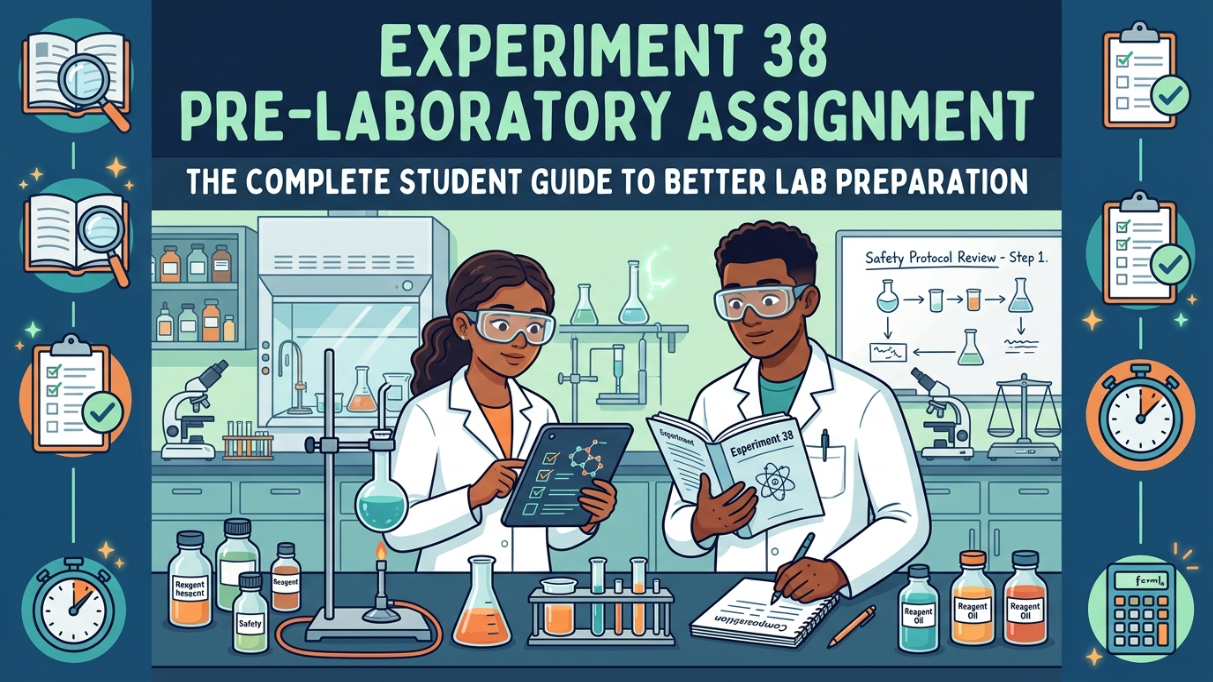
Experiment 38 Pre Laboratory Assignment: The Complete Student Guide to Better Lab Preparation
Preparing for a laboratory session is much more than completing a required worksheet. A well-written experiment 38 pre laboratory assignment helps students understand scientific concepts before entering the lab, minimizes mistakes, improves safety, and creates a stronger foundation for meaningful experimental analysis. Instead of viewing it as routine homework, successful students recognize it as an essential part of scientific learning.
Whether you are studying chemistry, biology, physics, or another laboratory-based discipline, mastering the experiment 38 pre laboratory assignment can significantly improve your confidence and performance. This guide explains everything you need to know, from understanding its purpose to creating high-quality submissions that demonstrate genuine scientific understanding.
Understanding the Purpose of an Experiment 38 Pre Laboratory Assignment
The primary objective of an experiment 38 pre laboratory assignment is to prepare students before they begin practical work. It introduces theoretical concepts, expected procedures, laboratory equipment, and potential hazards so students arrive ready to perform experiments efficiently.
Rather than memorizing instructions, students learn how scientific principles connect with practical applications. This preparation encourages critical thinking, reduces confusion during experiments, and allows instructors to focus on deeper scientific discussions instead of basic procedural explanations.
Why Pre-Laboratory Assignments Matter
Many students underestimate how much preparation affects laboratory success. Completing an experiment 38 pre laboratory assignment helps identify knowledge gaps before they become costly mistakes during the experiment, leading to more accurate observations and stronger analytical skills.
Laboratory work often involves expensive equipment, sensitive chemicals, or precise measurements. Adequate preparation promotes safe practices while improving confidence, efficiency, and overall academic performance throughout the course.
Essential Components Included in the Assignment
Although institutions may organize materials differently, most versions of an experiment 38 pre laboratory assignment include several common sections designed to verify readiness before laboratory participation.
The following table summarizes the typical elements and their educational purpose.
| Assignment Component | Purpose | Benefit for Students |
|---|---|---|
| Experiment Objective | Defines learning goals | Creates clear expectations |
| Scientific Background | Explains relevant theory | Builds conceptual understanding |
| Laboratory Procedure | Reviews experimental steps | Improves workflow efficiency |
| Safety Considerations | Identifies hazards and precautions | Reduces laboratory risks |
| Equipment Overview | Introduces instruments and materials | Familiarizes students with tools |
| Data Preparation | Creates tables or observation sheets | Saves valuable lab time |
| Prediction Questions | Encourages hypothesis development | Strengthens critical thinking |
| Calculations | Prepares required formulas | Minimizes calculation errors |
Understanding each component allows students to approach laboratory activities with greater organization and confidence while improving the overall quality of experimental results.
How to Prepare Effectively Before Writing
Before starting the experiment 38 pre laboratory assignment, carefully review the laboratory manual, lecture notes, and instructor guidelines. Building a complete understanding of the experiment makes every section easier to complete accurately.
It also helps to identify unfamiliar scientific terms, review related textbook chapters, and gather reference materials early. Investing additional preparation time usually results in a more thoughtful assignment and smoother laboratory performance.
Common Mistakes Students Should Avoid
One of the most frequent problems is treating the experiment 38 pre laboratory assignment as a task to finish quickly rather than an opportunity to prepare thoroughly. Copying answers without understanding the material often leads to confusion during the actual experiment.
Another common mistake involves overlooking laboratory safety requirements or skipping calculations until the experiment begins. These shortcuts increase stress, reduce efficiency, and may negatively affect both grades and laboratory outcomes.
Strategies for Producing High-Quality Work
Strong assignments begin with understanding instead of memorization. Reading each section carefully, summarizing concepts in your own words, and connecting theoretical ideas to laboratory procedures demonstrate genuine comprehension.
Reviewing completed work before submission is equally important. Correct terminology, accurate calculations, and organized formatting help create an experiment 38 pre laboratory assignment that reflects careful preparation and academic professionalism.
The Role of Scientific Thinking in Laboratory Preparation
Laboratory education is designed to develop scientific reasoning rather than simple procedural skills. A carefully completed experiment 38 pre laboratory assignment encourages students to predict outcomes, evaluate variables, and consider possible sources of experimental error before beginning practical work.
This mindset transforms laboratory sessions from step-by-step exercises into opportunities for investigation. Students become active participants in scientific inquiry instead of merely following written instructions.
Laboratory Safety Starts Before Entering the Lab
Laboratory safety begins long before protective goggles are worn or equipment is handled. Reading safety protocols as part of an experiment 38 pre laboratory assignment allows students to recognize chemical hazards, emergency procedures, and appropriate protective equipment.
Prepared students respond more effectively to unexpected situations because they already understand potential risks. This proactive approach protects individuals, classmates, instructors, and laboratory facilities while supporting responsible scientific practice.
Improving Academic Performance Through Better Preparation
Research across science education consistently shows that students who prepare thoroughly before laboratory sessions perform better during practical exercises and produce more accurate reports. The experiment 38 pre laboratory assignment serves as an important bridge between classroom theory and laboratory application.
Preparation also reduces cognitive overload during experiments. Instead of trying to learn procedures and scientific concepts simultaneously, students can focus on collecting reliable data, making careful observations, and interpreting results with greater confidence.
“Success in the laboratory is determined long before the experiment begins through careful preparation, thoughtful planning, and scientific curiosity.”
Practical Example of Effective Preparation
Imagine two students attending the same laboratory session. One completes the experiment 38 pre laboratory assignment thoughtfully, understands the procedure, and anticipates possible challenges before arriving in class.
The second student quickly copies answers without reviewing the underlying concepts. During the experiment, the prepared student works confidently while the unprepared student frequently asks procedural questions, makes measurement errors, and struggles to analyze results. This comparison illustrates how preparation directly influences laboratory success.
Digital Learning and Modern Laboratory Preparation
Educational technology has transformed how students complete laboratory assignments. Digital simulations, interactive laboratory manuals, virtual experiments, and online scientific databases provide valuable resources that complement the experiment 38 pre laboratory assignment.
These tools help students visualize complex procedures before entering the laboratory. They also support independent learning by allowing repeated practice without consuming laboratory resources or creating safety risks.
Conclusion
Completing an experiment 38 pre laboratory assignment should never be viewed as a simple academic requirement. It is an essential learning tool that develops scientific understanding, strengthens analytical thinking, improves laboratory safety, and enhances overall academic performance.
Students who consistently prepare before laboratory sessions gain lasting benefits that extend beyond individual experiments. Better preparation leads to stronger scientific reasoning, greater confidence, improved grades, and a deeper appreciation of how theoretical knowledge becomes practical discovery.
FAQ
What is an experiment 38 pre laboratory assignment?
An experiment 38 pre laboratory assignment is a preparatory exercise completed before a laboratory session that helps students understand objectives, procedures, scientific theory, calculations, and safety requirements.
Why is an experiment 38 pre laboratory assignment important?
The experiment 38 pre laboratory assignment improves laboratory readiness, reduces mistakes, promotes safety, and helps students apply theoretical concepts more effectively during practical work.
How long should it take to complete an experiment 38 pre laboratory assignment?
Completion time varies depending on course complexity, but most students spend between 30 minutes and two hours reviewing materials, answering questions, and preparing calculations.
Can I complete an experiment 38 pre laboratory assignment without reading the laboratory manual?
While technically possible, doing so often leads to misunderstandings, incomplete answers, and poor laboratory performance because the manual contains essential procedures and scientific context.
How can I improve my experiment 38 pre laboratory assignment?
Improve your experiment 38 pre laboratory assignment by reviewing lecture notes, understanding scientific concepts instead of memorizing answers, checking calculations carefully, and proofreading your work before submission.