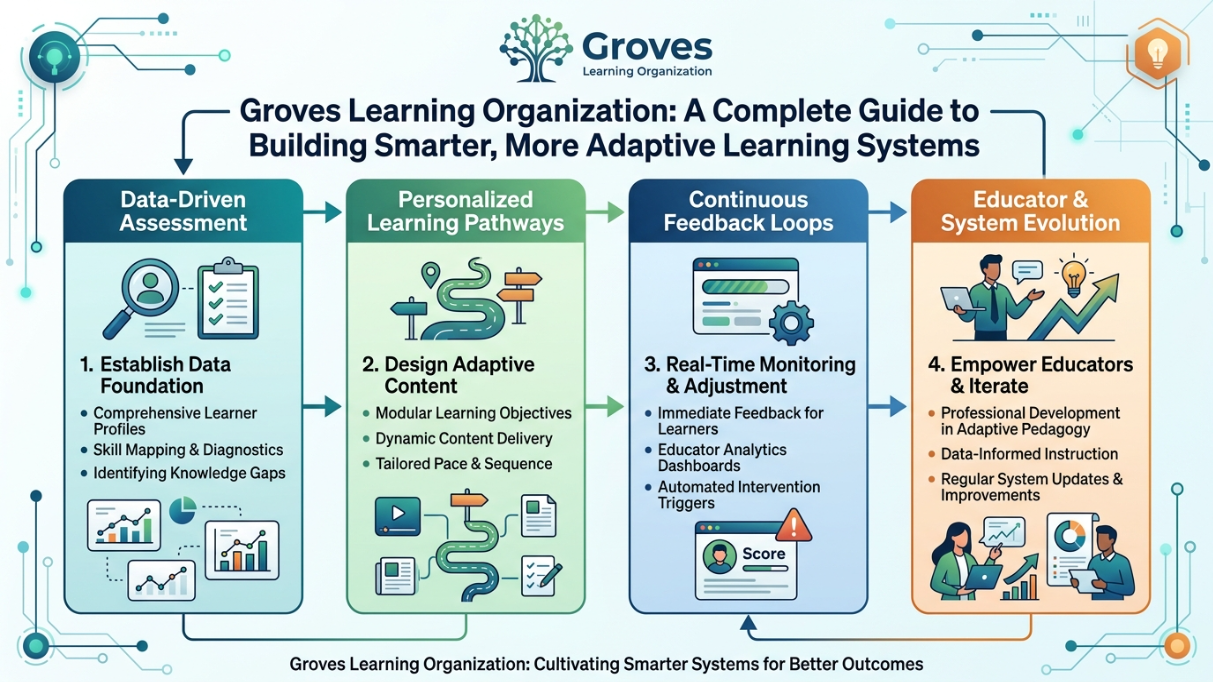
Groves Learning Organization: A Complete Guide to Building Smarter, More Adaptive Learning Systems
Modern organizations operate in an environment where change is constant and competitive advantages disappear quickly. Companies that continuously learn, adapt, and improve consistently outperform those that rely on static processes. This is where the concept of a groves learning organization becomes increasingly valuable. Rather than treating learning as an occasional training initiative, it embeds continuous improvement into everyday operations, decision-making, and leadership.
A groves learning organization encourages employees to expand their knowledge, share expertise, solve problems collaboratively, and transform experience into lasting organizational capability. When learning becomes part of the company culture, innovation accelerates, employee engagement improves, and businesses become more resilient in the face of uncertainty.
Understanding the Groves Learning Organization
A groves learning organization represents a workplace where learning is intentionally integrated into strategy, leadership, communication, and daily operations. Instead of viewing knowledge as something owned by individuals, it treats learning as a shared organizational asset that strengthens long-term performance.
The model emphasizes continuous development, knowledge sharing, critical thinking, experimentation, and reflection. Employees are encouraged to question existing assumptions, learn from both successes and failures, and contribute ideas that improve products, services, and internal processes.
Why Organizational Learning Matters More Than Ever
Today’s business landscape evolves through technological innovation, changing customer expectations, global competition, and economic uncertainty. Organizations that fail to learn quickly often struggle to remain competitive because outdated practices become barriers to growth.
A groves learning organization develops the capacity to respond rapidly to new challenges without losing strategic focus. Rather than reacting defensively, learning organizations anticipate change, adapt proactively, and convert uncertainty into opportunities for innovation and continuous improvement.
Core Principles Behind a Groves Learning Organization
Every successful groves learning organization is built upon several interconnected principles that reinforce one another across the entire business. These principles create an environment where learning becomes both systematic and sustainable.
Shared vision aligns employees around common goals, collaborative learning encourages cross-functional knowledge exchange, systems thinking improves decision-making, continuous feedback drives improvement, and reflective practice transforms everyday experiences into meaningful organizational knowledge that compounds over time.
Leadership’s Role in Creating a Learning Culture
Leadership determines whether learning becomes a genuine organizational value or simply another corporate slogan. Leaders establish the psychological environment in which employees either feel safe exploring new ideas or avoid taking calculated risks.
Effective leaders model curiosity, encourage thoughtful discussion, recognize learning achievements, and treat mistakes as valuable learning opportunities. Within a groves learning organization, leadership focuses less on controlling information and more on enabling knowledge creation across every level of the business.
Building Psychological Safety for Continuous Learning
Employees rarely contribute innovative ideas if they fear criticism or punishment. Psychological safety creates an atmosphere where questions, experimentation, and constructive disagreement are viewed as essential components of organizational growth.
When individuals trust that their contributions will be respected, collaboration naturally increases. A groves learning organization deliberately cultivates openness, allowing diverse perspectives to improve decision-making while strengthening employee confidence and engagement.
Knowledge Sharing as a Strategic Advantage
Many organizations possess valuable expertise that remains isolated within departments or individual employees. Knowledge silos reduce efficiency, slow innovation, and create unnecessary duplication of work.
A groves learning organization establishes systems that encourage documentation, mentoring, collaborative projects, internal communities of practice, and digital knowledge repositories. These practices ensure valuable insights remain accessible even as teams evolve and organizational priorities change.
Technology That Supports Organizational Learning
Technology has transformed how organizations capture, distribute, and apply knowledge. Modern digital platforms allow learning to become continuous rather than limited to scheduled training sessions.
Learning management systems, collaboration platforms, artificial intelligence, analytics dashboards, internal knowledge bases, and digital communication tools enable a groves learning organization to deliver learning resources at the exact moment employees need them most.
Comparison of Traditional Organizations and Learning Organizations
The differences between conventional management approaches and learning-centered organizations extend well beyond employee training. The following comparison illustrates how organizational philosophy influences long-term performance.
| Traditional Organization | Groves Learning Organization |
|---|---|
| Knowledge remains within departments | Knowledge flows across teams |
| Training occurs occasionally | Learning is continuous |
| Leaders primarily direct work | Leaders coach and develop people |
| Mistakes are often avoided or hidden | Mistakes become learning opportunities |
| Innovation happens selectively | Innovation becomes part of everyday work |
| Information travels slowly | Collaboration accelerates knowledge sharing |
| Change is often resisted | Adaptation is encouraged |
| Employees execute instructions | Employees contribute strategic ideas |
These distinctions demonstrate why organizations committed to continuous learning often respond more effectively to market shifts. Their competitive advantage comes not only from expertise but also from the ability to generate new knowledge faster than competitors.
Practical Benefits for Employees and Organizations
Continuous learning produces measurable improvements that extend beyond employee development. Organizations frequently experience stronger innovation, higher productivity, better customer satisfaction, improved operational efficiency, and increased employee retention.
Individuals benefit through expanded career opportunities, greater confidence, stronger problem-solving abilities, improved collaboration, and increased professional adaptability. Together, these outcomes reinforce the long-term value of a groves learning organization across every business function.
Common Challenges During Implementation
Transforming organizational culture requires patience because established habits rarely change overnight. Resistance often emerges when employees perceive learning initiatives as additional work rather than opportunities for growth.
Successful organizations address these concerns by communicating clear objectives, providing leadership support, allocating dedicated learning time, rewarding knowledge sharing, and demonstrating measurable improvements that reinforce the value of continuous development.
Measuring the Success of Organizational Learning
Learning initiatives should be evaluated using meaningful performance indicators rather than participation alone. Measuring outcomes helps leaders understand whether learning investments are producing strategic business value.
Useful metrics include employee engagement, innovation rates, internal mobility, collaboration quality, customer satisfaction, productivity improvements, retention, knowledge-sharing participation, leadership development, and overall organizational adaptability within a groves learning organization.
Emerging Trends Shaping Learning Organizations
Artificial intelligence, personalized learning, predictive analytics, immersive technologies, and skills-based workforce planning continue reshaping organizational learning. Businesses increasingly emphasize continuous capability development rather than static job descriptions.
Future-focused organizations also recognize the importance of interdisciplinary collaboration, digital literacy, and human-centered leadership. These trends strengthen the relevance of the groves learning organization as businesses prepare for increasingly complex operating environments.
A Practical Scenario of Organizational Transformation
Imagine a growing technology company experiencing rapid expansion across multiple regions. Different teams develop valuable solutions independently, yet knowledge rarely travels beyond departmental boundaries, resulting in duplicated effort and inconsistent customer experiences.
By adopting the principles of a groves learning organization, leadership introduces collaborative learning sessions, shared documentation, mentoring programs, continuous feedback systems, and cross-functional innovation workshops. Within months, teams solve recurring problems faster, onboarding improves significantly, employee engagement rises, and new product development becomes noticeably more efficient.
A Perspective That Reflects Continuous Learning
As management expert Peter Senge famously observed, “The only sustainable competitive advantage is an organization’s ability to learn faster than the competition.”
This insight remains highly relevant because organizational success increasingly depends not on possessing knowledge alone but on continuously generating, sharing, and applying it more effectively than competitors.
Conclusion
A groves learning organization represents far more than a modern management philosophy. It is a strategic framework for building organizations capable of sustained innovation, adaptability, resilience, and long-term growth. By embedding continuous learning into leadership, collaboration, decision-making, and daily operations, businesses create an environment where both employees and the organization thrive together.
Organizations that prioritize learning develop stronger cultures, make better decisions, respond more effectively to market change, and build capabilities that competitors cannot easily replicate. As industries continue evolving, investing in organizational learning is becoming less of an advantage and more of a necessity for enduring success.
FAQ
What is a groves learning organization?
A groves learning organization is an organization that embeds continuous learning, collaboration, knowledge sharing, and improvement into its everyday operations to achieve sustainable growth and innovation.
Why is a groves learning organization important?
A groves learning organization enables businesses to adapt quickly to change, improve employee performance, strengthen innovation, and maintain long-term competitive advantage.
How does leadership influence organizational learning?
Leaders create the culture that encourages curiosity, open communication, collaboration, experimentation, and continuous improvement while providing the resources employees need to keep learning.
What technologies support organizational learning?
Learning management systems, knowledge bases, collaboration software, artificial intelligence tools, analytics platforms, and digital communication technologies all strengthen organizational learning capabilities.
Can small businesses become a groves learning organization?
Absolutely. Small businesses often adapt even faster because they have fewer organizational layers. By encouraging collaboration, documenting knowledge, supporting employee development, and promoting continuous improvement, smaller organizations can successfully build a groves learning organization that scales with future growth.
Read More: List of Neurodivergent Disorders: A Complete Guide to Understanding Neurodiversity