
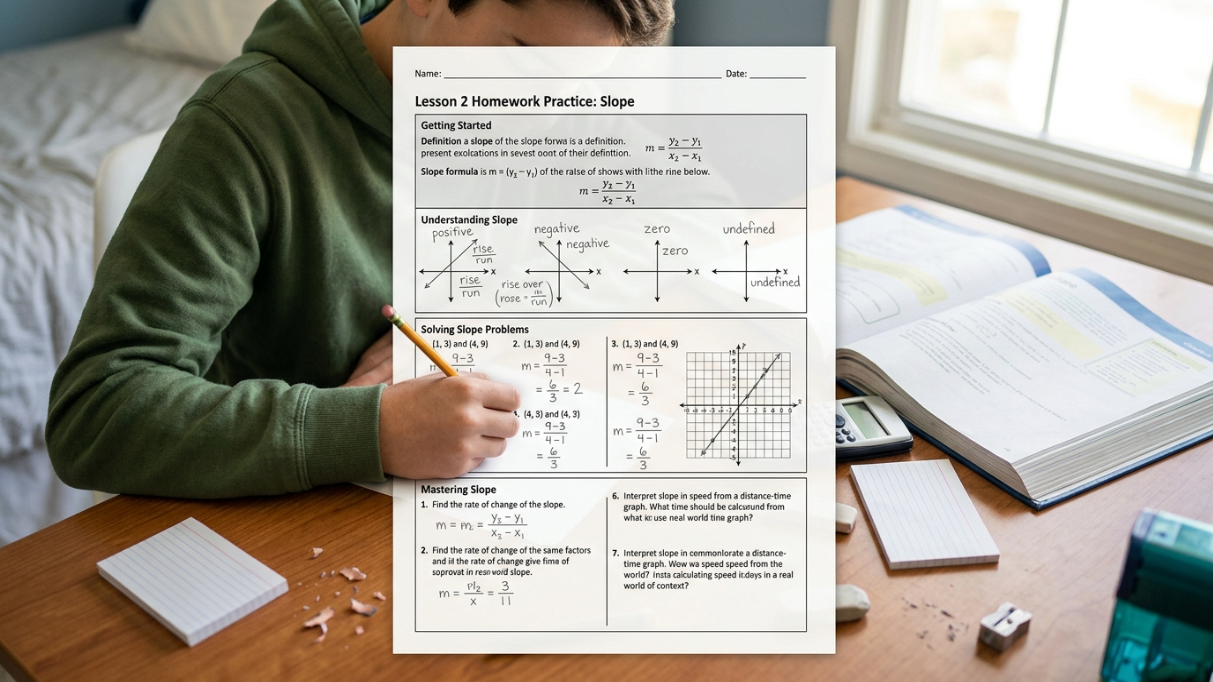
Lesson 2 Homework Practice Slope: Complete Guide to Understanding, Solving, and Mastering Slope Problems
Understanding lesson 2 homework practice slope is one of the most important steps in building a strong foundation in algebra and coordinate geometry. Whether you’re completing homework, preparing for a quiz, or reviewing classroom concepts, mastering slope helps you understand how lines behave on a graph and how mathematical relationships are represented visually.
This comprehensive guide explains every essential concept related to lesson 2 homework practice slope, including formulas, interpretation, graph analysis, practical examples, and common mistakes. By the end, you’ll have a deeper understanding of slope and the confidence to solve problems accurately and efficiently.
Understanding Lesson 2 Homework Practice Slope
The concept behind lesson 2 homework practice slope focuses on measuring how steep a line is between two points on a coordinate plane. Slope describes the rate of change, showing how much the vertical value changes compared to the horizontal movement.
Students typically encounter slope through graphs, coordinate pairs, tables, and real-world situations. Learning to identify positive, negative, zero, and undefined slopes creates a strong mathematical foundation for later topics such as linear equations, graphing, and algebraic modeling.
Why Slope Matters in Mathematics
Slope is much more than a classroom concept. It represents change, direction, and relationships between variables, making it one of the most useful ideas in mathematics. Understanding lesson 2 homework practice slope prepares students for future coursework involving functions, statistics, and calculus.
In everyday life, slope appears in roads, wheelchair ramps, construction projects, roof design, engineering, finance, and data analysis. Recognizing these applications helps students appreciate why learning slope has practical value beyond homework assignments.
The Formula Used in Lesson 2 Homework Practice Slope
The standard slope formula compares the vertical change to the horizontal change:
Slope (m) = (y₂ − y₁) ÷ (x₂ − x₁)
Applying this formula correctly is central to lesson 2 homework practice slope. Always subtract coordinates in the same order for both numerator and denominator to avoid calculation errors and incorrect signs.
Types of Slopes Students Should Recognize
Every line falls into one of four basic slope categories. Identifying them quickly improves both graph interpretation and equation solving during lesson 2 homework practice slope.
| Slope Type | Appearance | Value | What It Means |
|---|---|---|---|
| Positive | Rises left to right | Positive number | Increasing relationship |
| Negative | Falls left to right | Negative number | Decreasing relationship |
| Zero | Horizontal line | 0 | No vertical change |
| Undefined | Vertical line | Undefined | No horizontal change |
Recognizing these patterns visually often saves time before performing calculations. Many homework exercises combine graphical recognition with numerical computation to strengthen conceptual understanding.
Solving Problems Step by Step
A successful approach to lesson 2 homework practice slope begins by identifying the two coordinate points correctly. Next, calculate the vertical difference, followed by the horizontal difference, before dividing the two values.
After finding the answer, verify whether the sign makes sense by looking at the graph. If the line rises from left to right, the slope should be positive. If it falls, the result should be negative. This simple check helps catch arithmetic mistakes before submitting homework.
Common Mistakes Students Make
One of the most frequent errors during lesson 2 homework practice slope is reversing the subtraction order for only one coordinate. Consistency matters because changing the order in only the numerator or denominator changes the final answer.
Another common issue occurs when students divide by zero or misunderstand vertical and horizontal lines. Carefully examining the graph before calculating reduces confusion and improves overall accuracy.
Practical Examples That Build Confidence
Imagine two points located at (2, 3) and (6, 11). The vertical change equals 8 while the horizontal change equals 4, producing a slope of 2. This indicates the line rises two units for every one unit moved to the right.
Another example involves points (4, 8) and (4, 2). Since the horizontal change equals zero, the slope is undefined. Exercises like these frequently appear in lesson 2 homework practice slope, helping students distinguish between different line behaviors.
Strategies for Completing Homework Successfully
Success with lesson 2 homework practice slope comes from practicing multiple problem types rather than memorizing isolated procedures. Work with graphs, coordinate tables, equations, and word problems to strengthen conceptual understanding.
Checking every solution after completion also improves long-term performance. Reviewing signs, simplifying fractions, and verifying graph direction are quick habits that dramatically reduce careless mistakes.
Real-World Connections That Reinforce Learning
Slope measures rates of change found throughout everyday life. Engineers calculate road grades, architects design accessible ramps, economists analyze financial trends, and scientists measure changing data using slope-based models.
Connecting these applications to lesson 2 homework practice slope makes abstract mathematics easier to understand. Students often retain concepts longer when they recognize meaningful real-world uses beyond classroom exercises.
Expert Tips for Improving Accuracy
Building confidence requires consistent practice and careful reasoning instead of rushing through problems. Reviewing worked examples before attempting independent exercises strengthens understanding and helps identify recurring patterns.
As mathematician George Pólya famously said, “If you can’t solve a problem, then there is an easier problem you can solve first.” This advice encourages students working on lesson 2 homework practice slope to simplify difficult questions and build confidence step by step.
Conclusion
Mastering lesson 2 homework practice slope provides the foundation for understanding linear relationships, graphing equations, and solving increasingly advanced mathematical problems. Rather than memorizing formulas alone, students benefit most from understanding why slope represents change and how it appears in different mathematical contexts.
With regular practice, careful calculations, and thoughtful review, lesson 2 homework practice slope becomes far less intimidating. The skills developed through slope exercises continue supporting success in algebra, geometry, statistics, and many real-world problem-solving situations.
FAQ
What is lesson 2 homework practice slope?
Lesson 2 homework practice slope typically teaches students how to calculate, interpret, and graph the slope of a line using coordinate points, equations, and graphs.
Why is lesson 2 homework practice slope important?
Lesson 2 homework practice slope introduces the concept of rate of change, which serves as a foundation for algebra, geometry, linear equations, and higher-level mathematics.
What formula is used in lesson 2 homework practice slope?
The standard formula is (y₂ − y₁) ÷ (x₂ − x₁). Keeping the subtraction order consistent ensures accurate results throughout lesson 2 homework practice slope exercises.
How can I improve my lesson 2 homework practice slope skills?
Practice solving problems from graphs, coordinate pairs, and tables while checking your work carefully. Consistent review helps build confidence and accuracy in lesson 2 homework practice slope.
What are the four types of slope?
The four types are positive, negative, zero, and undefined. Recognizing these categories makes lesson 2 homework practice slope easier because students can quickly interpret graph behavior before calculating exact values.
Read More: Roberto Bob Morales