
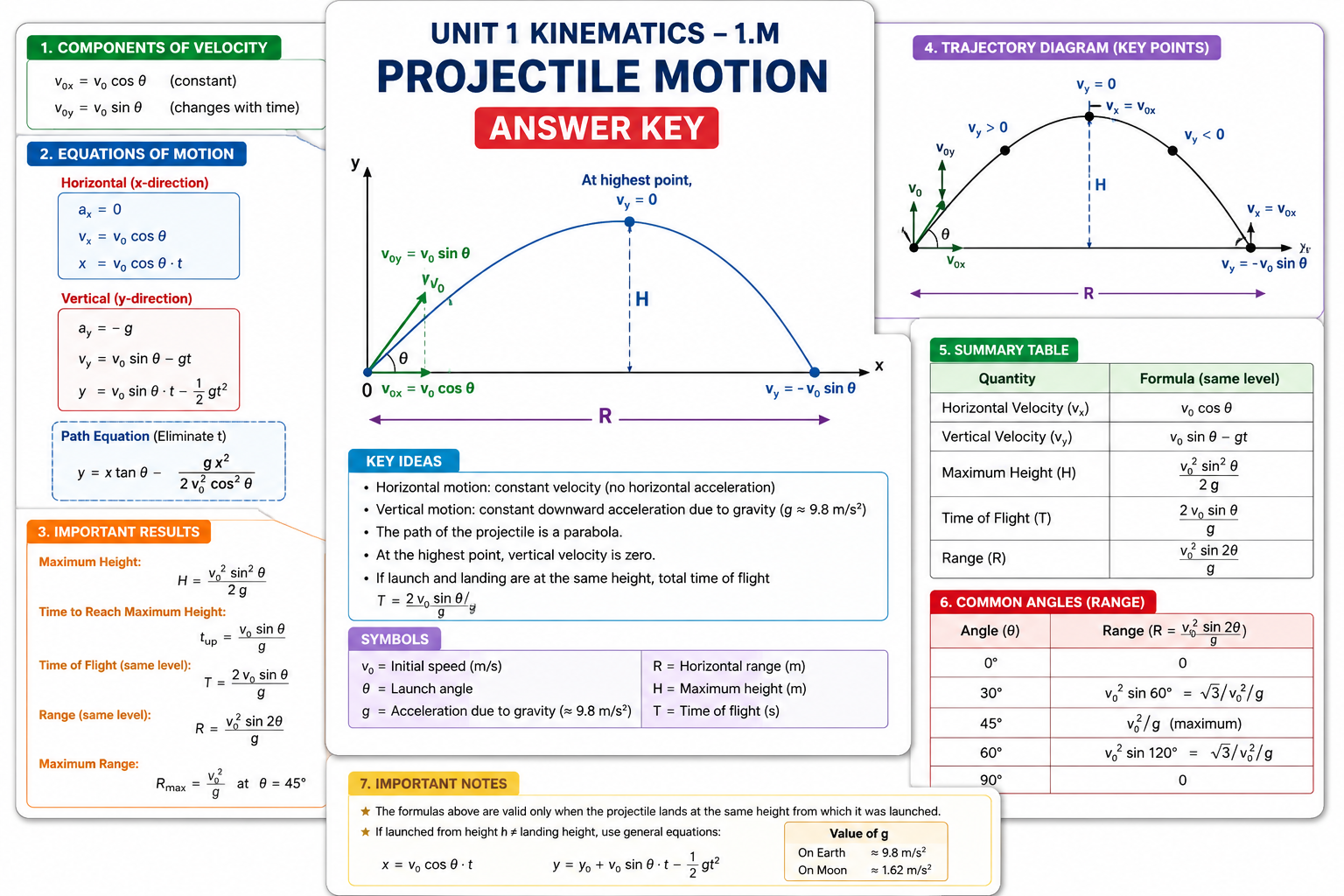
Unit 1 Kinematics 1.M Projectile Motion Answer Key: Complete Study Guide and Solutions
Understanding the unit 1 kinematics 1.m projectile motion answer key is about much more than checking whether an answer is correct. A high-quality answer key explains the reasoning behind each solution, reinforces fundamental physics concepts, and helps students recognize patterns that appear throughout kinematics assessments.
Whether you are preparing for quizzes, classroom assignments, standardized examinations, or simply reviewing projectile motion, this comprehensive guide explains how the unit 1 kinematics 1.m projectile motion answer key can become a powerful learning tool rather than just a list of final answers.
Understanding the Purpose of the Answer Key
The unit 1 kinematics 1.m projectile motion answer key serves as a reference for verifying calculations while reinforcing the principles behind projectile motion. Instead of encouraging memorization, an effective answer key demonstrates how equations, diagrams, and reasoning work together to solve motion problems accurately.
Projectile motion combines independent horizontal and vertical motion under constant gravitational acceleration. Learning why each answer is correct helps students strengthen conceptual understanding, identify calculation errors, and build confidence before more advanced physics topics.
Core Concepts Behind Projectile Motion
Projectile motion occurs whenever an object moves through the air under the influence of gravity while air resistance is ignored. The horizontal velocity remains constant, while the vertical velocity changes continuously due to gravitational acceleration.
When reviewing the unit 1 kinematics 1.m projectile motion answer key, students should pay close attention to variables such as displacement, initial velocity, launch angle, time of flight, maximum height, and horizontal range. Recognizing how these quantities interact makes solving future questions significantly easier.
Essential Projectile Motion Equations
Physics students should understand the formulas before relying on the unit 1 kinematics 1.m projectile motion answer key. Knowing when and why each equation applies improves problem-solving speed and accuracy.
The following table summarizes the most important equations commonly used throughout Unit 1.
| Concept | Formula | Purpose | Common Mistake |
|---|---|---|---|
| Horizontal Velocity | Vx = V cos θ | Calculates constant horizontal speed | Using gravity in horizontal motion |
| Vertical Velocity | Vy = V sin θ | Determines upward or downward speed | Mixing sine and cosine |
| Horizontal Distance | x = Vx × t | Finds horizontal displacement | Using changing velocity |
| Vertical Position | y = Vy × t − ½gt² | Calculates vertical displacement | Forgetting negative gravity |
| Maximum Height | H = Vy² / 2g | Determines highest point | Squaring incorrectly |
| Time of Flight | T = 2Vy / g | Finds total air time | Using horizontal velocity |
| Range | R = Vx × T | Calculates landing distance | Mixing units |
How to Use the Answer Key Effectively
Many students only compare their final answer with the unit 1 kinematics 1.m projectile motion answer key. While this confirms correctness, it rarely improves long-term understanding because it ignores the reasoning behind the solution.
A better approach involves solving every problem independently before consulting the answer key. Compare each calculation step, identify exactly where mistakes occurred, and rewrite the complete solution correctly. This process develops analytical thinking and reduces repeated errors.
Common Mistakes Students Make
Projectile motion problems often appear difficult because multiple variables change simultaneously. However, most errors result from a few recurring misconceptions rather than complex mathematics.
Students using the unit 1 kinematics 1.m projectile motion answer key frequently confuse horizontal and vertical motion, substitute incorrect values into equations, forget unit conversions, or apply formulas outside their intended situations. Carefully reviewing each solution helps eliminate these habits over time.
Worked Example and Practical Application
Imagine a ball launched at 20 m/s with a 45-degree angle. The first step is separating the initial velocity into horizontal and vertical components before calculating flight time, maximum height, and horizontal range.
Comparing your calculations with the unit 1 kinematics 1.m projectile motion answer key allows you to verify not only the numerical results but also the logical sequence of solving the problem. Understanding the workflow prepares students for unfamiliar examination questions that require deeper reasoning.
Why Conceptual Understanding Matters More Than Memorization
Memorizing solutions may help on identical practice questions, but physics examinations often introduce different numerical values or slightly modified scenarios. Conceptual understanding allows students to adapt confidently regardless of the problem format.
As physicist Richard Feynman famously said, “What I cannot create, I do not understand.” This idea reflects the importance of reconstructing each solution rather than simply copying it from the unit 1 kinematics 1.m projectile motion answer key.
Study Strategies for Better Physics Performance
Consistent practice remains the most effective method for mastering projectile motion. Short daily study sessions produce stronger retention than infrequent marathon review sessions because concepts remain active in long-term memory.
Students should solve a variety of projectile motion questions before reviewing the unit 1 kinematics 1.m projectile motion answer key. Mixing conceptual questions, graphical analysis, numerical calculations, and word problems develops a balanced understanding that extends beyond classroom assessments.
How Teachers and Tutors Use Answer Keys
Educators rely on answer keys not simply to assign grades but to identify learning patterns. Repeated mistakes often reveal misunderstandings that require additional explanation instead of simple correction.
A carefully prepared unit 1 kinematics 1.m projectile motion answer key also helps tutors explain alternative solution methods, demonstrate efficient calculation techniques, and encourage students to verify every step rather than focusing only on the final answer.
Conclusion
The unit 1 kinematics 1.m projectile motion answer key is most valuable when treated as a learning resource instead of merely an answer sheet. By studying each equation, understanding the reasoning behind every calculation, and correcting mistakes systematically, students develop stronger analytical skills that extend throughout physics education.
Mastering projectile motion requires consistent practice, careful review, and conceptual understanding. When combined with active problem-solving, the unit 1 kinematics 1.m projectile motion answer key becomes an essential companion for achieving higher grades, improving confidence, and building a solid foundation in kinematics.
FAQ
What is the unit 1 kinematics 1.m projectile motion answer key?
The unit 1 kinematics 1.m projectile motion answer key provides verified solutions and explanations for projectile motion problems, helping students understand calculations and physics concepts.
Why should I study the steps instead of only the answers?
Reviewing every step improves conceptual understanding, helps identify mistakes, and prepares you for new problems that differ from practice exercises in the unit 1 kinematics 1.m projectile motion answer key.
Which formulas are most important for projectile motion?
Students should master equations for horizontal velocity, vertical velocity, displacement, time of flight, maximum height, and horizontal range before depending on the unit 1 kinematics 1.m projectile motion answer key.
How can I avoid common projectile motion mistakes?
Separate horizontal and vertical motion, maintain consistent units, choose the correct equation, and compare your complete solution with the unit 1 kinematics 1.m projectile motion answer key to identify errors.
Is the answer key enough to prepare for exams?
No. The unit 1 kinematics 1.m projectile motion answer key works best when combined with regular practice, conceptual review, and solving unfamiliar problems independently before checking the solutions.
Read More: Kirk Gerndt: Leadership, Career, and Influence in Modern Construction