List of Neurodivergent Disorders: A Complete Guide to Understanding Neurodiversity
The list of neurodivergent disorders has become an increasingly important topic as awareness of neurodiversity continues to grow across education, healthcare, and workplaces. Rather than viewing neurological differences as deficits alone, modern perspectives recognize that people experience, process, and interact with the world in diverse ways.
Understanding the list of neurodivergent disorders helps families, educators, employers, clinicians, and individuals build more inclusive environments while identifying appropriate support strategies. Although every person has unique strengths and challenges, learning about the conditions commonly associated with neurodivergence creates a stronger foundation for empathy, informed decision-making, and practical accommodations.
What Does Neurodivergent Mean?
Neurodivergent describes individuals whose brain development or cognitive functioning differs from what society traditionally considers typical. The term emerged from the neurodiversity movement, which emphasizes that neurological differences are a natural part of human diversity rather than something that always requires correction.
When discussing the list of neurodivergent disorders, it is important to remember that neurodivergence is not a medical diagnosis itself. Instead, it is an umbrella concept that includes several developmental, cognitive, learning, and mental health conditions that affect thinking, communication, learning, sensory processing, behavior, or executive functioning.
Why Understanding the List of Neurodivergent Disorders Matters
Learning the list of neurodivergent disorders allows individuals to recognize signs earlier and seek appropriate professional evaluation when necessary. Early understanding often leads to better educational planning, workplace accommodations, mental health support, and improved quality of life.
Greater awareness also reduces stigma. Many neurodivergent individuals possess exceptional creativity, analytical thinking, innovation, memory, attention to detail, or problem-solving abilities that flourish when environments are designed to support different learning and communication styles.
Complete List of Neurodivergent Disorders
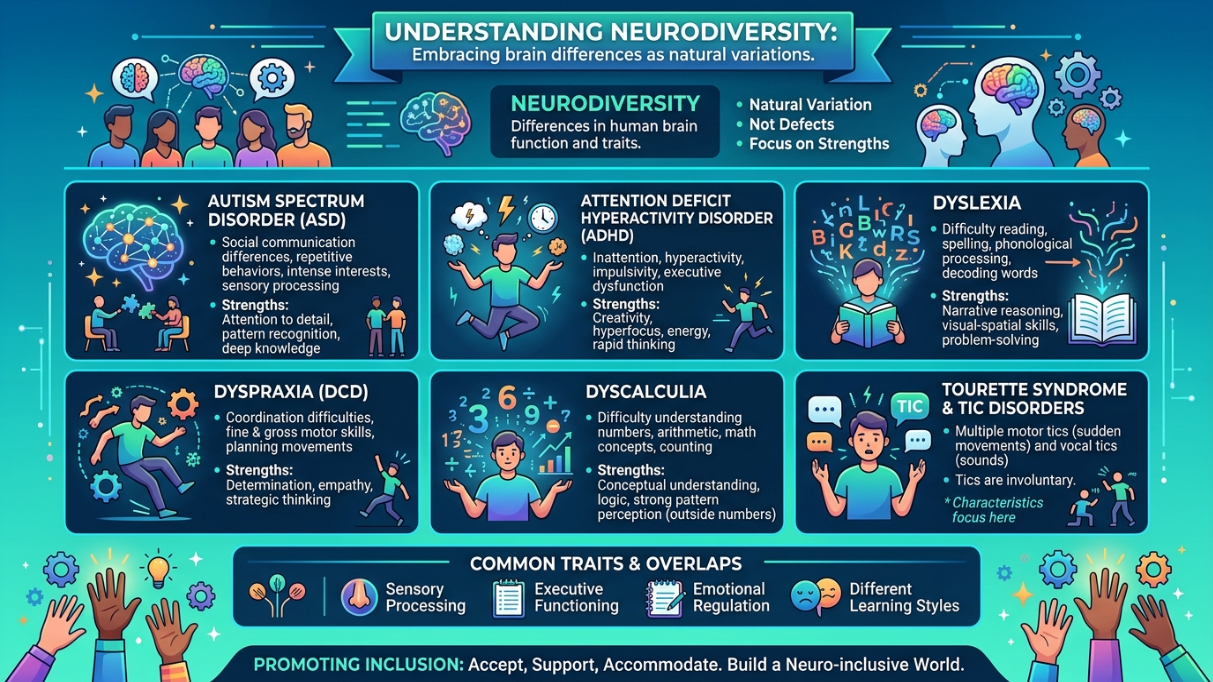
The following table provides a broad overview of conditions commonly included when discussing the list of neurodivergent disorders. Some conditions are universally recognized within neurodiversity discussions, while others may vary depending on clinical, educational, or advocacy perspectives.
| Condition | Primary Characteristics | Common Challenges | Potential Strengths |
|---|---|---|---|
| Autism Spectrum Disorder (ASD) | Social communication differences, repetitive behaviors, sensory differences | Social interaction, sensory overload | Pattern recognition, honesty, deep focus |
| Attention-Deficit/Hyperactivity Disorder (ADHD) | Inattention, impulsivity, hyperactivity | Organization, executive functioning | Creativity, adaptability, energy |
| Dyslexia | Reading and language processing differences | Reading fluency, spelling | Visual thinking, creative reasoning |
| Dyscalculia | Difficulty understanding numbers and mathematical concepts | Arithmetic, calculations | Strong verbal or creative abilities |
| Dysgraphia | Challenges with handwriting and written expression | Writing speed, organization | Oral communication, conceptual thinking |
| Dyspraxia (Developmental Coordination Disorder) | Motor coordination differences | Fine and gross motor skills | Strategic thinking, persistence |
| Tourette Syndrome | Motor and vocal tics | Social misunderstanding | Resilience, adaptability |
| Obsessive-Compulsive Disorder (often discussed within neurodiversity communities) | Intrusive thoughts and compulsions | Anxiety, repetitive behaviors | Attention to detail |
| Intellectual Disability (in some neurodevelopmental contexts) | Cognitive and adaptive functioning differences | Learning pace | Individual strengths vary widely |
| Sensory Processing Differences | Unusual responses to sensory input | Noise, textures, lighting | Heightened sensory awareness |
The list of neurodivergent disorders should never be viewed as a rigid classification. Individuals may experience more than one condition simultaneously, and symptoms often exist on a spectrum rather than fitting into clearly defined categories.
Autism Spectrum Disorder
Autism Spectrum Disorder is among the most recognized conditions included in the list of neurodivergent disorders. Autism affects communication, social interaction, sensory processing, and behavior, although every autistic individual presents a unique combination of characteristics.
Some autistic people require substantial daily support, while others live independently and excel in highly specialized careers. Interests may become areas of exceptional expertise, making many autistic individuals valuable contributors in technology, science, engineering, education, creative arts, and research.
Attention-Deficit/Hyperactivity Disorder (ADHD)
ADHD is characterized by persistent patterns of inattention, impulsivity, hyperactivity, or a combination of these traits. Executive functioning challenges often affect organization, planning, time management, and sustained attention.
Despite these challenges, many individuals with ADHD demonstrate remarkable innovation, rapid idea generation, resilience, and entrepreneurial thinking. Structured routines, coaching, medication when appropriate, and environmental adjustments often significantly improve daily functioning.
Learning Differences Within Neurodiversity
Learning differences such as dyslexia, dyscalculia, dysgraphia, and dyspraxia are frequently included in discussions surrounding the list of neurodivergent disorders because they influence how people acquire and process information rather than reflecting intelligence.
Many successful professionals, entrepreneurs, scientists, artists, and business leaders have learning differences. Appropriate educational interventions, assistive technology, and individualized instruction often help learners unlock their full potential while building confidence and independence.
Conditions Sometimes Included in Neurodiversity Discussions
Certain conditions, including Tourette Syndrome, Obsessive-Compulsive Disorder, sensory processing differences, and some anxiety-related conditions, are sometimes included in broader neurodiversity conversations. Inclusion often depends on the context, research framework, or advocacy perspective being used.
This variation explains why different resources may present slightly different versions of the list of neurodivergent disorders. While clinical classifications evolve with research, the underlying goal remains improving understanding, acceptance, and access to meaningful support.
Common Characteristics Across Neurodivergent Conditions
Although every condition differs, several characteristics may appear across multiple forms of neurodivergence. Executive functioning challenges, sensory sensitivities, communication differences, emotional regulation, working memory, and processing speed are common themes.
It is equally important to recognize strengths alongside challenges. Many neurodivergent individuals demonstrate exceptional creativity, original thinking, strong ethical values, deep concentration on interests, innovative problem-solving, and remarkable persistence when pursuing meaningful goals.
Diagnosis, Assessment, and Professional Evaluation
Receiving an accurate diagnosis usually involves comprehensive assessments conducted by qualified healthcare professionals, psychologists, neurologists, psychiatrists, or multidisciplinary teams. Evaluations often include interviews, standardized assessments, developmental history, educational records, and behavioral observations.
The list of neurodivergent disorders should never be used for self-diagnosis alone. Self-education is valuable, but professional assessment provides the most reliable pathway toward personalized treatment plans, educational accommodations, workplace support, and long-term success.
Support Strategies That Make a Difference
Effective support begins with understanding each individual’s strengths, preferences, and challenges rather than applying one-size-fits-all solutions. Flexible communication, sensory accommodations, predictable routines, visual supports, and individualized learning strategies often produce meaningful improvements.
Inclusive environments benefit everyone. Schools, employers, healthcare providers, and families that embrace neurodiversity often discover increased innovation, stronger collaboration, improved wellbeing, and better outcomes for both neurodivergent and neurotypical individuals.
Common Misconceptions About Neurodivergence
One widespread misconception is that neurodivergence automatically limits intelligence or future success. In reality, intelligence exists across every neurological profile, and many neurodivergent individuals achieve outstanding accomplishments in academics, business, science, sports, and the arts.
Another misunderstanding assumes that everyone on the list of neurodivergent disorders experiences identical symptoms. Each condition exists on a continuum, and every person’s combination of strengths, challenges, personality, environment, and life experiences creates a unique profile.
The Future of Neurodiversity Awareness
Growing research continues to reshape how society understands brain diversity. Schools increasingly implement inclusive teaching methods, employers expand workplace accommodations, and healthcare systems improve screening and early intervention services.
As awareness expands, conversations surrounding the list of neurodivergent disorders are shifting from focusing solely on limitations toward recognizing capability, accessibility, belonging, and long-term success. This balanced perspective helps individuals receive support while celebrating the diversity of human cognition.
Conclusion
Understanding the list of neurodivergent disorders provides more than medical knowledge—it encourages empathy, inclusion, and informed support for millions of people worldwide. Neurodivergence represents natural variation in how human brains function, learn, communicate, and solve problems.
Rather than asking how individuals should fit into existing systems, society increasingly asks how systems can better support different ways of thinking. That shift benefits not only neurodivergent people but also families, educators, workplaces, and communities that value diverse perspectives and talents.
“Neurodiversity may be every bit as crucial for the human race as biodiversity is for life in general.” — Harvey Blume
FAQ
What is the list of neurodivergent disorders?
The list of neurodivergent disorders commonly includes Autism Spectrum Disorder, ADHD, dyslexia, dyscalculia, dysgraphia, dyspraxia, Tourette Syndrome, sensory processing differences, and several other neurodevelopmental conditions depending on the context.
Is neurodivergent an official medical diagnosis?
No. Neurodivergent is an umbrella term rather than a formal diagnosis. The conditions within the list of neurodivergent disorders each have their own diagnostic criteria established by clinical guidelines.
Can someone have more than one neurodivergent condition?
Yes. Many people experience co-occurring conditions, such as autism and ADHD or dyslexia and dysgraphia, making individualized assessment especially important.
Does being neurodivergent always require treatment?
Not necessarily. Some people seek therapy, coaching, medication, or educational support, while others primarily benefit from accommodations, understanding, and environments designed around their strengths.
Why does the list of neurodivergent disorders vary between sources?
Different medical organizations, researchers, and neurodiversity advocates sometimes include different conditions based on evolving evidence and varying definitions of neurodivergence, which is why the list of neurodivergent disorders is not always identical across publications.