Universityequality com: A Complete Guide to Academic Equality and Inclusive Education
Education is most effective when every learner has equal opportunities to grow, participate, and succeed. As universities continue embracing digital transformation, platforms that encourage accessibility, fairness, and inclusion are becoming increasingly valuable. This is where universityequality com stands out as an important concept for anyone interested in modern higher education.
Whether you are a student searching for reliable educational guidance, an educator exploring inclusive practices, or an institution seeking better equality strategies, universityequality com represents a meaningful approach to improving educational experiences. This guide explores its value, practical applications, and the broader role it plays in supporting accessible, equitable, and student-centered learning.
Understanding Universityequality com
At its core, universityequality com represents a resource focused on educational equality, accessibility, and inclusive learning practices. Rather than limiting success to academic achievement alone, it emphasizes creating opportunities that allow every learner to participate without unnecessary barriers.
Its broader significance lies in connecting students, educators, and institutions with ideas that support fairness in admissions, learning environments, digital accessibility, student engagement, and campus inclusion. These principles continue shaping higher education worldwide as universities adapt to changing learner needs.
Why Educational Equality Matters
Educational equality goes beyond offering identical resources to every student. It involves recognizing different learning needs and providing appropriate support so individuals can achieve comparable opportunities for success throughout their academic journey.
Through this perspective, universityequality com aligns with modern educational priorities by highlighting accessibility, diversity, inclusion, student wellbeing, and equitable participation. These values strengthen learning communities while encouraging academic excellence for people from varied backgrounds.
The Core Principles Behind Universityequality com
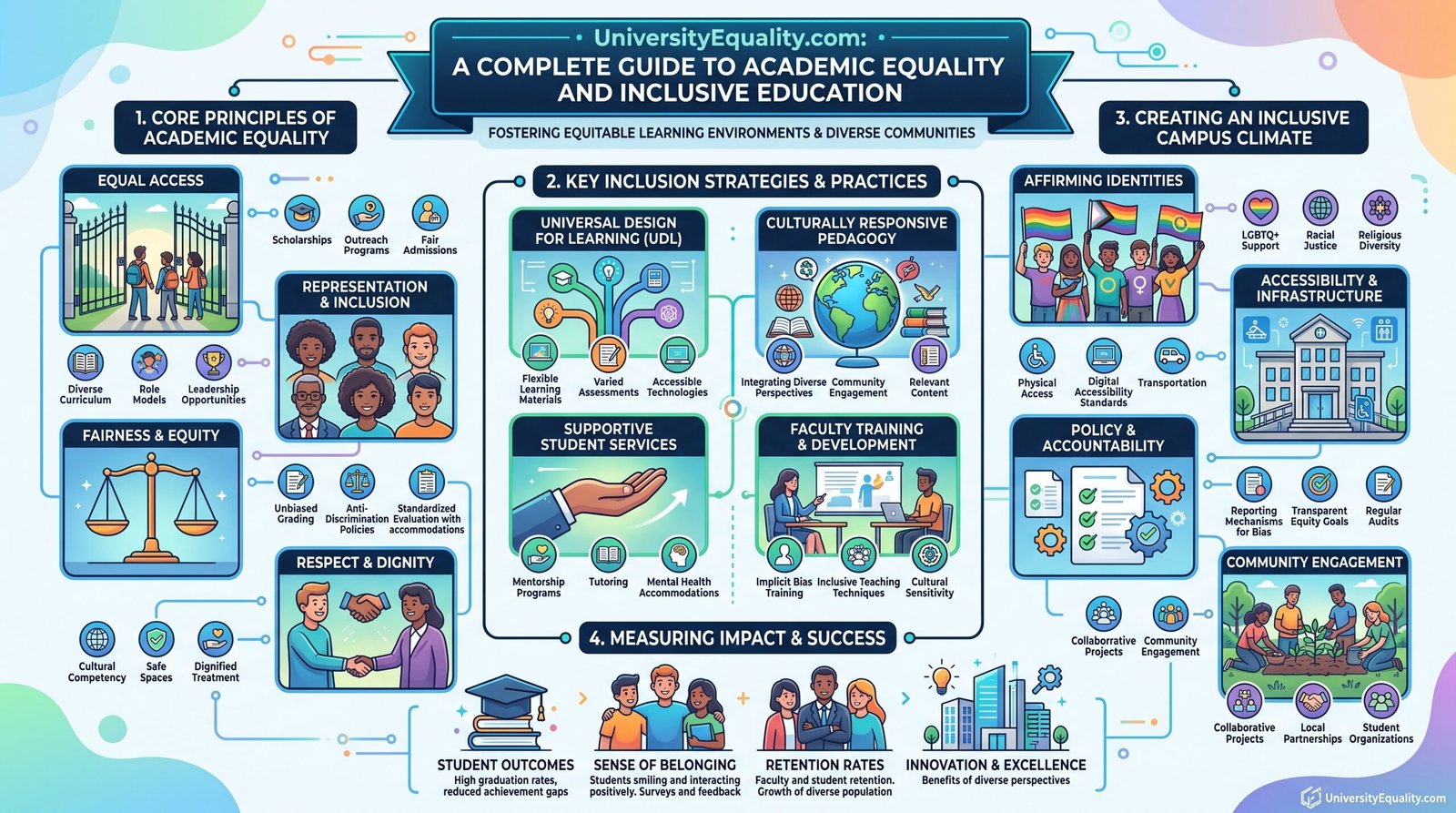
Several foundational principles contribute to the value associated with universityequality com. These include equal access to educational resources, inclusive teaching methods, transparent institutional policies, and continuous improvement through student feedback.
Another essential principle involves removing barriers before they become obstacles. Whether addressing digital accessibility, financial challenges, disability accommodations, or cultural inclusion, proactive planning creates stronger educational outcomes for everyone involved.
Key Features and Educational Focus
Many users associate universityequality com with educational guidance, awareness, and practical information surrounding equality initiatives in higher education. Instead of focusing on one narrow topic, it connects multiple aspects of inclusive academic development.
These areas often include accessibility standards, diversity programs, student support services, learning technologies, academic policies, campus culture, and professional development. Together they create a comprehensive framework that supports sustainable educational improvement.
| Area | Primary Objective | Practical Benefit |
|---|---|---|
| Accessibility | Remove learning barriers | Better participation for all students |
| Diversity | Encourage broad representation | Richer academic perspectives |
| Inclusion | Build welcoming learning environments | Greater student engagement |
| Student Support | Improve academic success | Higher retention and confidence |
| Digital Learning | Expand educational access | Flexible learning opportunities |
| Institutional Policy | Promote fairness | Transparent academic processes |
| Community Engagement | Encourage collaboration | Stronger campus culture |
How Students Benefit
Students often encounter challenges that extend beyond coursework, including financial pressures, accessibility concerns, social integration, and adapting to university life. Resources inspired by universityequality com help address these issues by encouraging informed decision-making and inclusive academic support.
When learners understand available services and equality initiatives, they are better positioned to participate confidently in classroom discussions, extracurricular activities, research opportunities, and career preparation while feeling supported throughout their educational experience.
Advantages for Universities and Educators
Universities increasingly recognize that inclusive education improves both student satisfaction and institutional reputation. By adopting principles associated with universityequality com, institutions can strengthen academic quality while creating environments where diverse perspectives contribute to innovation.
Educators also benefit by gaining greater awareness of inclusive teaching strategies, accessible learning materials, flexible assessment methods, and effective classroom communication. These improvements enhance learning outcomes without compromising academic standards.
Accessibility as a Strategic Priority
Accessibility is no longer viewed as an optional enhancement. Instead, it has become a strategic requirement for modern educational institutions seeking to serve increasingly diverse student populations through both physical and digital learning environments.
The philosophy reflected by universityequality com encourages universities to consider website accessibility, learning management systems, assistive technologies, captioned multimedia, readable content structures, and inclusive instructional design from the beginning rather than as afterthoughts.
Building Inclusive Campus Communities
A truly inclusive campus extends beyond classroom instruction. It involves creating respectful environments where every student feels welcomed regardless of background, identity, ability, or personal circumstances throughout their educational journey.
Community engagement, mentoring initiatives, student organizations, peer support programs, and open communication all contribute to stronger campus relationships. These practices complement the broader educational goals often associated with universityequality com by promoting belonging alongside academic achievement.
Digital Transformation and Future Trends
Technology continues reshaping higher education through online learning, hybrid classrooms, artificial intelligence, adaptive learning systems, and data-driven student support. These innovations offer significant opportunities to improve educational equality when implemented thoughtfully.
As expectations evolve, universityequality com remains relevant by encouraging institutions to balance technological advancement with fairness, accessibility, privacy, and inclusive educational practices. Future success depends not only on innovation but also on ensuring that innovation benefits every learner.
Practical Applications in Everyday Education
Imagine a university introducing new digital learning tools without considering accessibility. Some students could struggle with navigation, screen readers, or multimedia content, creating unnecessary barriers despite good intentions and advanced technology.
Applying principles connected with universityequality com encourages planning that considers diverse learner experiences from the beginning. This proactive approach improves participation, reduces frustration, and supports more consistent academic success across the entire student community.
Common Misconceptions
Some people mistakenly believe educational equality means lowering academic expectations or treating every student identically. In reality, equality focuses on creating fair opportunities while maintaining meaningful academic standards and encouraging individual achievement.
Another misconception is that inclusion benefits only specific groups. In practice, strategies promoted through universityequality com improve learning experiences for everyone by making educational environments clearer, more flexible, and more responsive to different learning styles.
Expert Perspective
As educational researcher Carol Dweck observed, “Becoming is better than being.” This perspective reflects the importance of continuous growth, improvement, and opportunity within higher education rather than fixed assumptions about ability or potential.
The broader philosophy connected with universityequality com aligns with this mindset by encouraging institutions to build environments where learners continually develop through access, encouragement, inclusion, and meaningful educational support.
Conclusion
Educational equality continues shaping the future of universities around the world. Institutions that prioritize accessibility, inclusion, transparency, and student success create stronger learning environments capable of meeting both current and future educational challenges.
For students, educators, and academic leaders alike, universityequality com represents more than a keyword. It symbolizes a commitment to creating educational systems where opportunity is expanded, barriers are reduced, innovation serves everyone, and academic excellence becomes genuinely accessible across diverse learning communities.
FAQ
What is universityequality com?
Universityequality com refers to a concept centered on educational equality, accessibility, inclusive learning, and fair opportunities within higher education.
Who can benefit from universityequality com?
Students, educators, university administrators, researchers, and anyone interested in improving educational accessibility and inclusion can benefit from the ideas associated with universityequality com.
Why is universityequality com important?
Universityequality com highlights practices that help create more equitable learning environments, improve student engagement, and support long-term academic success.
How does universityequality com support accessibility?
It encourages accessible learning resources, inclusive digital experiences, supportive institutional policies, and educational practices designed to reduce barriers for diverse learners.
Can universityequality com help universities improve student outcomes?
Yes. By promoting fairness, accessibility, inclusion, and student-centered strategies, universityequality com supports stronger engagement, improved retention, and a more positive educational experience.